
Table of Contents
- Why Non-Toxic Baby Products Matter More Than Ever in 2026
- How We Chose: Our Non-Toxic Baby Products Evaluation Criteria
- Best Non-Toxic Baby Toys for Sensory Development
- Non-Toxic Baby Feeding Products: Mealtime Essentials
- Why Food-Grade Silicone Baby Products Are a Smart Choice
- Your Non-Toxic Baby Registry Checklist for 2026
- Frequently Asked Questions
Last Updated: October 14, 2026
Why Non-Toxic Baby Products Matter More Than Ever in 2026
Babies explore the world with their mouths, and that simple fact drives every decision we make at Baby Hues.
Non-toxic baby products are items made without ingredients or materials linked to health concerns in infants, such as BPA, phthalates, and synthetic fragrance. "Non-toxic" isn't a regulated term, so the label alone tells you very little. What counts is the ingredient list, the material, and whether an independent lab has verified the product against a recognised standard.
That's the part most guides gloss over. A product can call itself "natural" or "eco" while still containing synthetic fragrance or unverified plastics.
The ACCC guidance on country of origin and product claims is a useful starting point for understanding which claims Australian businesses can legally make, and which ones are just decoration.
How We Chose: Our Non-Toxic Baby Products Evaluation Criteria
Most roundups tell you what they recommend and skip the part that matters: how they decided. We publish the method so you can apply it to any product, including ones we don't sell.
We screen every item against five weighted criteria. A product has to pass all five to make the list, there is no partial credit.
| Criterion | Weight | What Good Looks Like | Red Flag |
|---|---|---|---|
| Material transparency | High | Named material (food-grade silicone, untreated beechwood, stainless steel) | "Mixed materials" or "eco blend" with no detail |
| Independent testing | High | Tested to a named Australian standard, with the standard stated | "Non-toxic" with no testing reference at all |
| Exposure profile | High | No BPA, phthalates, or synthetic fragrance; no leaching risk under heat | Fragrance listed as "parfum" or "fragrance" |
| Durability | Medium | Survives dishwasher and steriliser cycles for 12+ months | "Hand wash only" for an everyday item |
| End-of-life | Medium | Single-material construction, recyclable or long service life | Glued joints, hidden seams, mixed plastics |
Hazard versus exposure: the distinction most guides skip
A chemical being "linked to health concerns" is not the same as it harming your baby. Risk depends on three things: how toxic the substance is, how much of it is present, and how much actually gets into the body. A trace residue in a toy your baby mouths for two minutes is a very different exposure from a plasticiser that leaches into hot food every day.
That's why we prioritise the products where exposure is highest and most repeated, feeding items that meet heat and food, and teething items that spend hours in the mouth, over items with brief, low-contact use. This is the same hazard-versus-exposure logic regulators use when setting safety limits, and it's why "contains a trace of X" headlines rarely tell the full story.
How we score, in practice
Each criterion is scored pass or fail. An item that fails material transparency or independent testing is removed regardless of how well it performs elsewhere. Durability and end-of-life are tie-breakers between otherwise comparable products.
We also apply a cost-per-use test. A $15 bowl used twice a day for two years works out to a few cents per meal; a $5 bowl replaced four times costs more and creates four times the waste. Sticker price is the least useful number on the page.
Finally, we re-check every recommendation against the ACCC product safety recalls database before publishing and after any recall notice. A product that has been recalled is removed immediately, not footnoted.
What we don't do
We don't treat "natural," "organic," or "eco" as evidence of safety. Those terms are not regulated in the way most parents assume, and a plant-based ingredient can still be a sensitiser. We don't recommend a product because a brand paid for placement. And we don't claim a product is risk-free, we claim it's a lower-exposure choice based on the criteria above.
Best Non-Toxic Baby Toys for Sensory Development
The best non-toxic baby toys are simple, mouthable, and built from a single verifiable material. For teething babies, that usually means food-grade silicone or untreated beechwood.
Two picks stand out in our range. The Silicone Teething Ball ($14.99) is a nesting ball set in food-grade silicone, sized at 10.5 by 10.5 by 10.5cm, and tested for Australian toy standards. It's designed to keep little hands and mouths busy during the teething period.

The Silicone and Beechwood Teething Ring ($16.99) suits babies from three months, with a mix of surfaces for sensory exploration and a shape that's easy for small hands to grip. It measures 10 by 11 by 1.5cm.
Both are BPA-free and built for repeated washing, which matters when a toy spends half its life on the floor.
Non-Toxic Baby Feeding Products: Mealtime Essentials
Mealtime is where chemical exposure adds up fastest, because food, heat, and repeated washing all interact with the container.
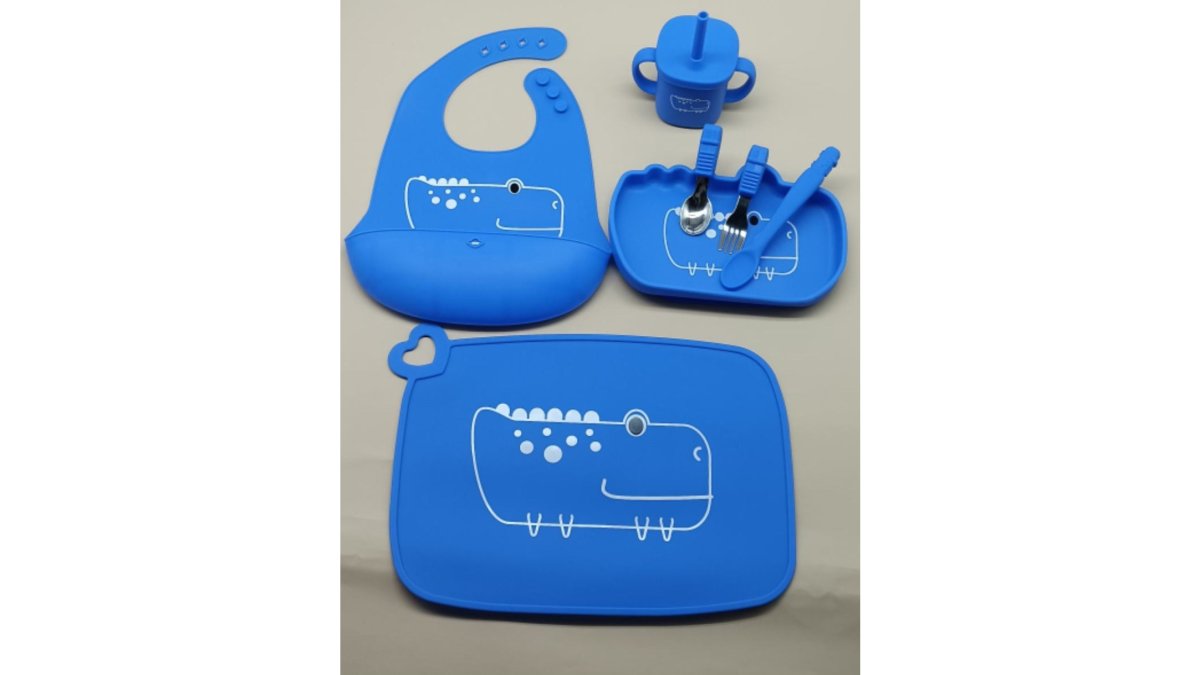
Our Silicone 7 Piece Dinner Set ($69.95) covers the whole routine: a placemat, a suction plate, a sippy cup with straw, a silicone feeding spoon, and a two-piece palm-grasp spoon and fork set with stainless steel heads.

If you'd rather build the set gradually, start with the Silicone Bowl ($14.95). The suction base restricts movement, which makes it close to spill-proof for a learner, and it's microwave and dishwasher safe.
Soft Silicone Snack Time Fork & Spoon Set →
The Soft Silicone Snack Time Fork & Spoon Set ($8.45) is the cheapest way to test whether your baby takes to silicone utensils before committing to a full set.
Why Food-Grade Silicone Baby Products Are a Smart Choice
Food-grade silicone is a synthetic material made from silica, and it's chosen for baby products because it's heat-stable, flexible, and doesn't leach into food the way some plastics can. It's also free of BPA, which is the main reason parents seek it out.
Three practical advantages matter day to day:
- Heat tolerance. Silicone handles microwave and dishwasher temperatures without deforming, so you can reheat and sterilise in the same item.
- No shatter risk. Unlike ceramic or hard plastic, silicone won't break into sharp pieces when a toddler throws it.
- Long service life. A single silicone bowl typically outlasts several cheaper alternatives, which changes the real cost per year.
That last point is worth dwelling on. The Silicone 2 Piece Divided Plate with Lid ($22.50) has three sections and a lid, so you can portion meals ahead of time. A plate that doubles as storage replaces two separate purchases.

The Placemat with Animal Designs ($21.95) follows the same logic. It's dishwasher safe, BPA-free, and doubles as a craft surface, so it stays in use well past the puree stage.
Your Non-Toxic Baby Registry Checklist for 2026
A useful registry is short, staged, and honest about priorities. Not every swap matters equally. The items your baby mouths for hours or eats from daily carry far more exposure than a decorative item they touch for seconds. We've ordered this list by stage and flagged which purchases are worth prioritising.
Newborn (0-3 months): low priority
At this stage, exposure is dominated by what touches skin and what goes in the mouth. Most newborns aren't yet using feeding gear, so the highest-value swaps are skincare and anything that contacts the face.
- Priority: Fragrance-free wash and lotion, synthetic fragrance is one of the most common skin sensitisers in this age group.
- Lower priority: Nursery decor and soft furnishings. Nice to get right, but brief, low-contact exposure.
Infant (3-6 months): high priority
This is when mouthing starts and teething gear enters daily, repeated contact.
- Teething (3 months+): Silicone and Beechwood Teething Ring ($16.99)
- Teething (4 months+): Silicone Teething Ball ($14.99)
- Priority: One-piece silicone teethers over glued or seamed toys, no hidden moisture points, no mould risk.
Infant to toddler (6 months+): highest priority
Feeding gear is where exposure compounds, because food, heat, and repeated washing all interact with the container. This is the stage where spending more genuinely reduces exposure and total cost.
- First foods (6 months+): Soft Silicone Snack Time Fork & Spoon Set ($8.45)
- Daily meals (6 months+): Silicone Bowl ($14.95) or Divided Plate with Lid ($22.50)
- Drinking: Sippy Cup with Handles ($15.95) or Sippy Cup with Design ($15.00)
- Full setup: Silicone 7 Piece Dinner Set ($69.95)
- Mess control: Placemat with Animal Designs ($21.95)
Cost per use: the maths that changes the decision
Sticker price hides the real cost. Here's how the everyday items compare over a two-year window, assuming daily use.
| Item | Upfront | Typical lifespan | Cost per use (approx.) |
|---|---|---|---|
| Silicone Bowl | $14.95 | 2+ years | A few cents per meal |
| Cheaper plastic bowl | ~$5 | 6 months | Higher once replaced 4× |
| Silicone 7 Piece Dinner Set | $69.95 | 2+ years | Lower per item than buying separately |
| Divided Plate with Lid | $22.50 | 2+ years | Replaces a plate + storage container |
A $15 bowl used twice a day for two years costs a few cents per meal. A $5 bowl replaced four times costs more and creates four times the waste. The same logic applies across the set: buying the seven-piece set once usually beats assembling equivalents piece by piece.
Two checks before you finalise any registry
- Confirm the material is named. "Food-grade silicone," "untreated beechwood," or "stainless steel" is verifiable. "Mixed materials" is not.
- Confirm it's dishwasher or steriliser safe. This determines whether it survives the first year, which is what drives cost per use.
For recalls and safety alerts, monitor the ACCC product safety recalls database. It's the fastest way to find out if something you already own has been flagged, and it's the same source we check before every recommendation.
Frequently Asked Questions
What does non-toxic mean for baby products?
For baby products, non-toxic generally means they are made without harmful chemicals like BPA and phthalates. Look for products with clear ingredient lists and independent testing against Australian safety standards. Food-grade silicone is a common non-toxic material because it is stable and does not leach chemicals.
Are food-grade silicone baby products safe?
Yes, food-grade silicone is considered a safe choice for baby products. It is non-toxic, BPA-free, and does not react with food or liquids. It is also durable and can withstand high temperatures, making it suitable for dishwashers and sterilisers. Always check that the product is independently tested and meets relevant Australian toy or food-contact standards.
How can I check whether a baby product is safe?
Start by checking for safety certifications and independent testing claims. Look for products that meet Australian toy standards or food-contact regulations. Read the ingredient list and avoid known chemicals of concern. Check for recalls from the ACCC. Reputable brands provide transparent information about their materials and testing. When in doubt, choose simpler products with fewer materials.
What materials are best for baby toys and mealtime products?
Food-grade silicone is a top choice for mealtime products because it is non-toxic, flexible, and easy to clean. For toys, silicone and untreated beechwood are popular for their safety and durability. Avoid plastics that may contain BPA or phthalates. Look for products labelled BPA-free and non-toxic, and check that they are tested for Australian safety standards.
Are eco-friendly baby products always non-toxic?
Not always. Eco-friendly often refers to environmental impact, such as using sustainable materials or reducing waste. A product can be eco-friendly but still contain chemicals of concern. Always check the ingredient list and safety certifications. Look for products that are both sustainable and independently tested for non-toxic materials, such as food-grade silicone.
Building a safer nursery shouldn't require a chemistry degree or a spreadsheet of unverified claims. Baby Hues exists to make that choice simpler, with food-grade silicone products that are BPA-free, dishwasher and steriliser safe, and independently tested against Australian and New Zealand toy standards. Our range is built to develop fine motor and sensory skills while surviving real daily use. See All and start your registry with products you can verify.