
Table of Contents
- Building a Sustainable Nursery: What Actually Matters
- Eco-Friendly Nursery Essentials: The Room-by-Room Checklist
- Organic Baby Bedding: What to Look For in Cots and Sheets
- Eco-Friendly Baby Toys: Safe Play for Little Hands
- Dishwasher Safe Silicone Baby Products: Easy Clean, Less Waste
- Safety Standards and Certification: What to Check Before You Buy
- Budget and Lifecycle: Cost-Per-Use and End-of-Life Options
- Conclusion: Building a Nursery That Lasts
- Frequently Asked Questions
Last Updated: October 16, 2026
Building a Sustainable Nursery: What Actually Matters
Sustainable baby products for nursery use are items made from renewable, organic or recyclable materials that are independently tested for safety and built to last through multiple children.
The good news is that a nursery built around a few well-chosen sustainable baby products costs less over time than a room full of cheap items that fall apart. Below, we break down what to buy room by room, what certifications to check, and how to think about cost per use rather than sticker price.
Eco-Friendly Nursery Essentials: The Room-by-Room Checklist
Eco-friendly nursery essentials fall into four zones: sleep, changing, feeding, and play and care. Planning by zone stops you from buying duplicates, and it forces the harder question, where a cheaper item will genuinely do, and where it will not.
Sleep Zone: Cot, Mattress, Bassinet and Bedding
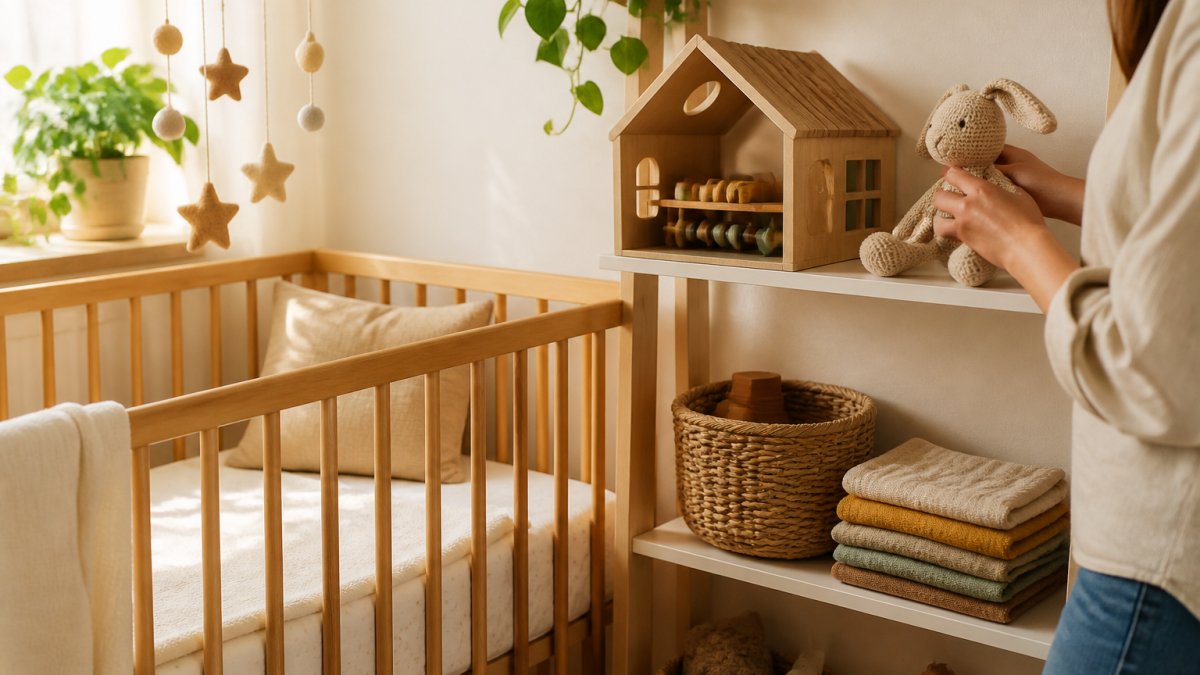
The cot and mattress are where you should spend the most and buy the least. A solid timber cot with a firm mattress and two or three sets of organic cotton sheets covers the first two years. Skip the bumpers, quilts, pillows and decorative cot liners entirely. Safe sleep guidance from Red Nose Australia recommends a firm, flat surface with a fitted sheet and nothing else in the cot.
- Cot material: Solid timber (pine, beech, or Australian-grown hardwood) is the durable choice. Look for a non-toxic, water-based finish rather than a solvent-based lacquer, and check that any painted surfaces are described as lead-free.
- Mattress: A firm, flat mattress with a removable, washable cover is the practical option. Latex and coconut-fibre mattresses are marketed as natural alternatives, but firmness and fit matter more than fibre type for safe sleep. The mattress must sit flush against the cot sides with no gaps wider than a finger.
- Bassinet: A bassinet is used for roughly the first six months. Because the use window is short, this is the zone where a hand-me-down or a second-hand bassinet with a new mattress makes the most sense, provided the frame is stable and the mattress is firm and fits correctly.
Changing Zone: Change Table, Mat and Wipes
The changing zone is where reusable items pay back fastest. A wipeable change mat with a removable cover, a stack of reusable cloth wipes, and a small lidded bin for soiled cloth covers the job. Reusable wipes are typically washed with the rest of the baby laundry, so they add almost no extra effort once a wash routine is in place.
Feeding Zone: Bottles, Bibs and Storage
Feeding gear is where material choice and dishwasher durability intersect. Food-grade silicone bibs with a catch pocket, glass or silicone bottles, and silicone or stainless-steel storage pouches all survive repeated high-temperature washing. Avoid polycarbonate bottles and any plastic marked with recycling code 7 unless the listing states it is BPA-free and tested to a recognised standard.
Play and Care Zone: Toys, Teethers, Towels and Skincare
Play items take the most punishment, so material quality matters more here than anywhere else. Food-grade silicone and untreated beechwood handle teething, dropping and dishwasher cycles without degrading. Our Baby Bath gift set ($39.95) bundles a 100% cotton hooded towel, bath mitt, and beechwood brush and comb set with natural goat bristles, which is a practical way to cover the whole care zone in one purchase.
Organic Baby Bedding: What to Look For in Cots and Sheets
Organic baby bedding means cotton grown without synthetic pesticides and processed without chlorine bleaching, and it matters most for the layer closest to your baby's skin. Look for a certified organic label rather than the word "natural," which has no legal definition in Australia.
A few things to check before buying:
- Certification: Look for a recognised organic textile standard on the label, not just marketing copy.
- Fit: Fitted sheets must be snug. Loose bedding is a suffocation risk.
- Weave: Muslin breathes well in warm weather; cotton jersey is softer for cooler months.
- Spares: Two or three sheet sets is enough. More just means more washing.
The Comforter blanket and teething ring set ($15.95) uses 100% cotton muslin with a detachable food-grade silicone teether, and the comforter separates for machine washing.

Eco-Friendly Baby Toys: Safe Play for Little Hands
Eco-friendly baby toys are made from renewable or recyclable materials such as cotton, linen, bamboo and food-grade silicone, with non-toxic finishes and no small parts that can break loose. The test is not whether a toy looks natural. It is whether it survives being chewed, dropped and washed.
Natural Materials That Hold Up
Linen and knitted cotton soft toys hold their shape through repeated washing, which is why we favour them over synthetic plush. Beechwood and bamboo resist splintering and are naturally antibacterial. Food-grade silicone flexes without cracking and handles both the dishwasher and a steriliser.
Top Picks for Playtime
- Bamboo activity house ($34.95): a bamboo house puzzle with five BPA-free food-grade silicone shapes. Suitable from 4 months, and it builds colour and shape recognition alongside fine motor skills.
- Sackable Nesting Round Blocks ($22.50): five multicoloured nesting blocks in food-grade silicone, dishwasher and steriliser safe, suitable from 6 months.
- Silicone and Beechwood teething ring ($16.99): easy for small hands to grip, with varied surfaces for sensory exploration. Suitable from 3 months.
- Silicone Teething Ball ($14.99): food-grade silicone, tested for Australian toy standards, sized for little hands.
Dishwasher Safe Silicone Baby Products: Easy Clean, Less Waste
Dishwasher safe silicone baby products are items moulded from food-grade silicone that withstand repeated high-temperature washing without warping, cracking or leaching.

Silicone holds up because it is heat-stable. It does not absorb odours the way porous materials can, and it does not develop the microscopic cracks that trap residue in cheaper plastics.
Delightful knitted toys with a gentle jiggling rattle. →
Place silicone on the top rack, skip the heated drying cycle where you can, and check for cloudiness or tackiness over time.
Safety Standards and Certification: What to Check Before You Buy
Safety certification means a product has been independently tested against a published standard. In Australia, the relevant framework is set by the ACCC product safety guidelines alongside the voluntary Australian/New Zealand toy standards. Independent testing is what separates a genuine claim from a label.
What Each Certification Actually Verifies
- Australian/New Zealand toy standards (AS/NZS ISO 8124): Covers mechanical and physical properties (sharp edges, small parts, cords), flammability, and migration of certain elements. It does not verify that a material is organic, renewable, or low-tox in a broader sense.
- Organic textile standards (such as GOTS): Verify the fibre is organically grown and that processing meets environmental and social criteria. They say nothing about toy safety, small parts, or flammability.
- Food-grade silicone claims: Indicate the material is suitable for contact with food. They do not by themselves confirm the item has passed toy-standard testing for small parts or pull strength.
- "Natural", "eco-friendly", "non-toxic" and "biodegradable": These are marketing terms without a single legal definition in Australia. "Biodegradable" in particular depends on conditions, a product marketed as biodegradable may only break down in industrial composting, not in a home bin or landfill.
A Pre-Purchase Checklist
- Does the listing name the specific standard the product was tested to?
- Is the testing described as independent, not in-house?
- Are age recommendations specific, such as "suitable from 3 months"?
- Are small parts, cords and detachable pieces accounted for?
How to Read a Sustainability Claim
A useful habit is to ask what the claim is evidence for. "Organic cotton" is evidence about how the fibre was grown. "Independently tested to AS/NZS ISO 8124" is evidence about physical safety.
Every product in our range is independently tested to meet Australian and New Zealand toy standards, and age suitability is printed on each listing so you can match the item to your baby's stage.
Budget and Lifecycle: Cost-Per-Use and End-of-Life Options
Cost per use is the only budget measure that matters in a nursery. A $15 teether used daily for eight months costs a few cents a day.
| Item | Price | Typical Use Window | What Happens at End of Life |
|---|---|---|---|
| Silicone teething ring | $16.99 | 3-18 months | Wipe down, pass on or donate |
| Nesting blocks | $22.50 | 6-24 months | Dishwasher clean, resell or hand down |
| Bamboo activity house | $34.95 | 4 months to 2 years | Timber and silicone separate for recycling |
| Cotton muslin comforter set | $15.95 | 4 months to 2 years | Machine wash, then textile recycling |
| Hooded bath towel | $22.95 | Birth to 3 years | Reuse as a small towel, then textile recycling |
Three habits stretch that further. Buy for the next stage, not the whole first year. Choose items that separate into materials you can recycle. Pass anything still intact to a family member or a local parent group rather than binning it.

Conclusion: Building a Nursery That Lasts
The challenge with a sustainable nursery is not finding eco-friendly labels. It is resisting the urge to buy everything at once, then replacing it all twelve months later.
At Baby Hues, every item in our range is food-grade, BPA-free and independently tested to Australian and New Zealand toy standards, with dishwasher and steriliser safe options across toys, teethers and bath essentials.
Frequently Asked Questions
What are the most important sustainable baby products for a nursery?
Focus on items your baby uses daily: organic cotton bedding, food-grade silicone teethers, and wooden or linen toys. These are the products that touch your baby's skin and mouth most often. Look for materials like organic cotton, sustainably harvested bamboo, and natural rubber or food-grade silicone. Prioritise items that are independently tested to Australian toy standards, dishwasher safe, and durable enough to last through multiple children.
How can I make a nursery more eco-friendly on a budget?
Start with second-hand furniture like cots and change tables, which are often in good condition and cost a fraction of new prices. Invest in new items where safety matters most, such as mattresses and teethers. Choose products with a high cost-per-use, like dishwasher safe silicone toys that replace multiple plastic items. Look for organic cotton bedding that can be washed and reused for years, and opt for gift sets that combine several essentials in one purchase.
Are silicone baby products safe and easy to clean?
Food-grade silicone is BPA-free, non-toxic, and safe for little hands and mouths. It does not harbour bacteria like some porous materials and can be washed by hand, in the dishwasher, or in a steriliser. Look for products tested to Australian toy standards, such as the Silicone Teething Ball or the Comforter Blanket and Teething Ring Set. Both are dishwasher and steriliser safe, making them practical for daily use.
What should I look for when buying an eco-friendly baby toy?
Check the materials first: organic cotton, linen, sustainably harvested bamboo, and food-grade silicone are good choices. Look for toys tested to Australian toy standards, which confirms they meet safety requirements for mouthing and handling. Consider durability: knitted cotton toys and beechwood teething rings hold up well over time. Avoid toys with small detachable parts for babies under three months. The Bamboo Activity House and the Silicone and Beechwood Teething Ring are both tested and suitable for different developmental stages.
Which nursery items are worth buying second-hand?
Cots, change tables, and nursery furniture are good second-hand buys if they meet current safety standards and have no missing parts. Avoid second-hand mattresses, as they can harbour allergens and lose firmness. Car seats and teething items should always be new for hygiene and safety reasons. For toys, wooden and plastic items can be cleaned thoroughly, but fabric toys with sentimental wear are best bought new to ensure they are washable and intact.