
Table of Contents
- Quick Comparison: 10 Durable Silicone Toys for Active Toddlers
- How to Choose Durable Toddler Toys That Survive Active Play
- Is Silicone Safe for Children's Toys? Standards and Testing Explained
- Sensory Toys for Toddlers: Building Skills Through Active Play
- Easy-to-Clean Toddler Toys: Dishwasher and Steriliser Care
- Top Silicone Toys for Active Toddlers: 10 Picks Under $40
- Common Mistakes When Buying Silicone Toys for Toddlers
- Frequently Asked Questions
Last Updated: October 13, 2026
Quick Comparison: 10 Durable Silicone Toys for Active Toddlers
Choosing durable silicone toys for active toddlers comes down to material thickness, verified safety testing, and how well each piece survives being thrown, chewed and dunked.
Here is the short version before the detail:
| Toy | Price | Best For | Key Feature |
|---|---|---|---|
| Food Grade Silicone Beach Set | $39.95 | Outdoor and sand play | 8 pieces, cotton mesh bag |
| Silicone Beach Set | $39.95 | Compact travel play | Fits in a nappy bag |
| Bath Time Bath Buddies | $21.00 | Bath sensory play | Pack of 4, 6 months plus |
| Bath Time Silicone Birds | $20.00 | Water play and squirting | Set of 3 squeezy birds |
| Silicone Teething Ball | $14.99 | Teething relief | Nesting ball set |
| Stackable Tower (Heart) | $24.50 | Fine motor stacking | Heart-shaped pieces |
| Stackable Tower (Star) | $24.50 | Sensory play and teething | Multi-shaped pieces |
| Nesting Round Blocks | $22.50 | Hand-eye coordination | 5 multicoloured pieces |
| Silicone Shapes Puzzle | $20.00 | Learning shapes and numbers | Soft, safe edges |
| Animal Puzzle | $20.00 | Problem solving | 10 textured pieces, 18 months plus |
Every item on this list sits under $40.

How to Choose Durable Toddler Toys That Survive Active Play
Durable toddler toys are built from thick, tear-resistant material that keeps its shape after repeated chewing, dropping and washing. Silicone flexes instead of cracking, and does not splinter like brittle plastics.
The most common mistake is judging durability by weight alone. What matters is wall thickness, how the piece is moulded, and whether the material springs back after stretching.
Thickness, Tear Resistance and Material Verification
Wall thickness is the best predictor of how long a silicone toy lasts. Thin silicone stretches permanently and tears at stress points, usually where a handle meets a body or a mould seam runs.
Ask three questions before buying:
- Does the listing state the material is food grade silicone, not just "silicone"?
- Is there a stated test standard, such as Australian and New Zealand toy standards?
- Are the dimensions listed so you can judge thickness against the size?
Is Silicone Safe for Children's Toys? Standards and Testing Explained
Silicone is safe for children's toys when it is food grade, free from BPA, and independently tested against recognised toy standards. It is chemically stable, which is why it is used for bakeware, baby bottles and teething products.
In Australia, toys are regulated through the Australian Consumer Law and the mandatory safety standard for toys for children up to 36 months, which the ACCC enforces. You can read the requirements directly at ACCC product safety for toys.
How to Verify a Safety Claim Before You Buy
Most parents rely on a badge or a phrase such as "non-toxic" and stop there. Check four things instead:
- Age rating. Look for an explicit "6 months+" or "18 months+" figure, not a vague "toddler" label. The rating reflects small-parts testing, so a toy rated 18 months+ may contain pieces that are a choking hazard for a younger child.
- Material disclosure. The listing should say "food grade silicone" rather than just "silicone" or "soft plastic", which tolerates heat and repeated washing without breaking down.
- BPA-free claim. Look for an explicit BPA-free statement. BPA is used in some hard plastics and resins and is not a component of pure silicone, so a genuine silicone product should carry the claim.
What the Standard Actually Covers
The mandatory standard for toys up to 36 months covers small parts that could be swallowed, sharp edges and points, and accessible cords or loops. It does not certify durability, so a toy can meet the standard and still fall apart within weeks. Safety compliance and durability are separate questions, and a good buying decision answers both.
Silicone-Specific Safety Considerations
Pure silicone is inert, so it does not react with saliva or release chemicals when heated. The risk sits in the fillers used in cheaper blends, which can become tacky, discolour, or develop a chemical smell after repeated dishwasher cycles. If a silicone toy develops a strong odour or sticky surface after washing, replace it.
Sensory Toys for Toddlers: Building Skills Through Active Play
Sensory toys for toddlers stimulate touch, sight, sound and movement while a child plays. They work because toddlers learn through their hands and mouths, not by being told how something works.
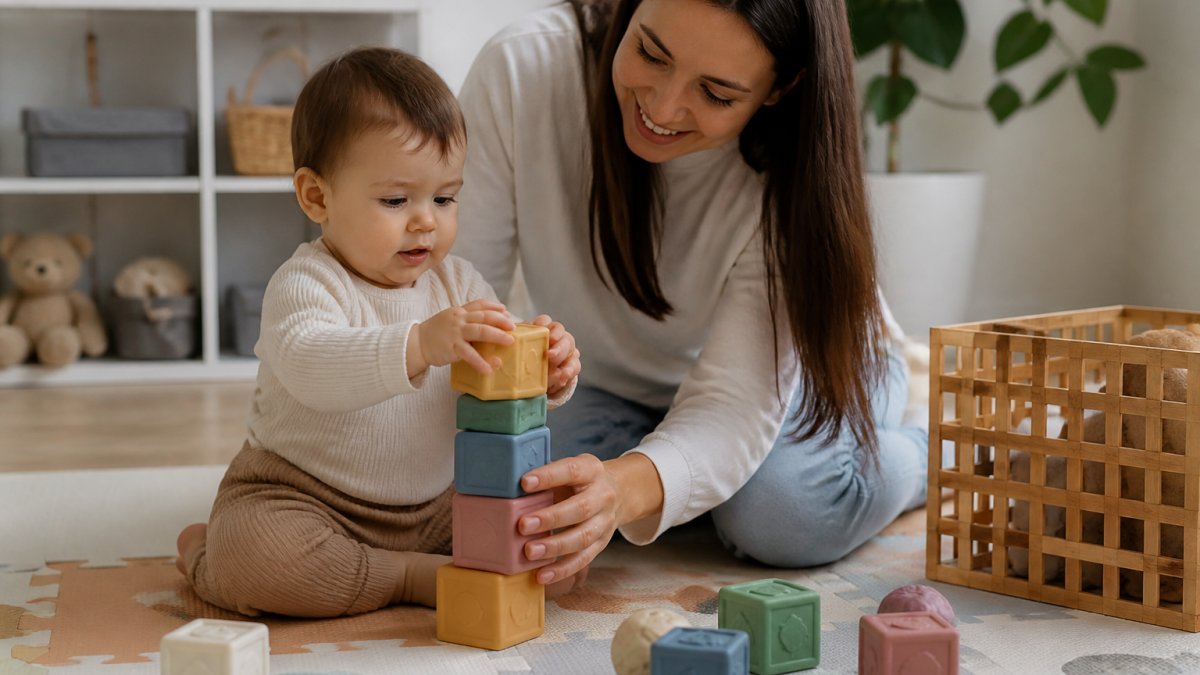
Fine Motor, Gross Motor and Tactile Exploration
Fine motor skills develop when a child pinches, stacks and fits pieces together. Gross motor skills build when they carry, throw, kick and chase. Tactile exploration happens when different textures pass through small hands.
A good silicone toy set covers more than one at once: a stackable tower trains the pincer grip, a beach set encourages carrying and scooping, and a textured puzzle adds the tactile layer.

Easy-to-Clean Toddler Toys: Dishwasher and Steriliser Care
Easy-to-clean toddler toys have smooth, non-porous surfaces and no hidden cavities where water and food collect. Food grade silicone fits that description, which is why so many mealtime and bath products use it. Dishwasher and steriliser safe means the material tolerates heat without warping or leaching, unlike toys with battery compartments or fabric seams.
How Silicone Behaves Under Heat and Repeated Washing
Silicone has a high heat tolerance, so it generally survives dishwasher cycles and steam or boiling sterilisation without losing shape. Repeated exposure to very high heat and harsh detergents can gradually dull the surface and make it slightly tacky, attracting dust and lint. That is a surface change rather than a structural failure, but worth watching.
A few care habits extend lifespan noticeably:
- Rinse straight after messy play so residue does not dry into seams or mould lines.
- Place small pieces in a dishwasher basket so they do not fall through the rack or lodge against a heating element.
- Wash on a normal cycle rather than a heavy-duty or high-temperature setting where the manufacturer allows it, to slow surface wear.
The Trapped-Water Problem in Squeeze Toys
Squeeze toys that fill with water are the hardest silicone items to keep hygienic, because water sits inside the cavity long after the outside is dry and can support mould. Squeeze out as much water as possible after each use, shake the toy, and air dry it in a well-ventilated spot. If it cannot be fully emptied or starts to smell, replace it.
Inspecting Silicone Toys for Damage
Silicone does not crack like brittle plastic, but it fails in specific ways that are easy to miss. Check for these signs while cleaning:
- Stretching that does not spring back. If a piece stays deformed after you release it, the elastic memory has weakened and the material is more likely to tear at stress points.
- Tears at seams or joins. Handles, spouts and mould lines are where thin silicone fails first.
- Surface tackiness or a chemical smell. Both suggest the material is degrading, which is more common in filler-blended products.
Drying and Storage
Air drying is safest for silicone because it avoids the heat that slowly wears the surface. Stand hollow pieces upside down so water drains out, and leave squeeze toys somewhere with airflow rather than packed tightly in a bag. Storing toys fully dry prevents the musty smell that builds when damp silicone sits in a closed container.
Food grade Silicone Beach set →
Top Silicone Toys for Active Toddlers: 10 Picks Under $40
Prices are current as of 2026.
Beach Sets, Bath Toys, Stackers and Puzzles
1. Food Grade Silicone Beach Set, $39.95. Our top pick for outdoor play.
**2.
3. Bath Time Bath Buddies, $21.00. A pack of four water sensory toys at roughly 5.5 x 5.5 x 8cm each, suitable from 6 months.

**4.
**5.
6. Stackable Tower in Heart Shape, $24.50. A star-shaped tower in a heart design.
7. Stackable Tower, Multi-Shape, $24.50. The same stacking concept with varied shapes.
**8.
9. Silicone Shapes Puzzle, $20.00. A soft puzzle that teaches shapes, colours and numbers.
10. Animal Puzzle, $20.00. Ten BPA-free pieces that fit together smoothly, suitable from 18 months.
Common Mistakes When Buying Silicone Toys for Toddlers
The most common mistake is buying on colour and price alone, then discovering the toy has no stated test standard. A close second is choosing toys that only suit one developmental stage, so they get abandoned within months.
Three more to watch for:
- Ignoring age suitability. A toy rated 6 months plus and one rated 18 months plus are built differently. Matching the rating to your child prevents frustration and safety issues.
- Assuming all silicone is equal. Food grade silicone and filler-blended silicone look similar on a shelf and behave very differently after a few months of chewing.
- Forgetting the cleaning routine. A toy that cannot go in the dishwasher will quietly stop being used.
Active toddlers will test every toy you buy, and most of what is on the market will not survive the first month. Baby Hues stocks toys that are independently tested to Australian and New Zealand toy standards.
Australian Competition and Consumer Commission product safety guidance
Frequently Asked Questions
What should I look for in a durable silicone toddler toy?
Check that the toy is made from 100% food-grade silicone and is labelled BPA-free. Look for testing against Australian and New Zealand toy standards, which confirms it has passed safety checks. Thicker silicone resists tearing better than thin, flimsy pieces, so squeeze the toy gently if you can. Dishwasher and steriliser safe labels are a good sign of quality. Also check the recommended age range so the toy suits your toddler's stage, and read parent reviews about how it holds up over months of active play.
Is silicone safe for children's toys?
Food-grade silicone is considered safe for children's toys when it is BPA-free and tested to recognised standards. Silicone is chemically stable, so it does not leach harmful substances the way some older plastics can. In Australia and New Zealand, reputable brands test their silicone toys against AS/NZS toy standards to verify safety. Avoid cheap unbranded silicone that has no testing information, and check for strong chemical smells or sticky surfaces, which suggest lower-quality material. Replace any toy that tears, cracks or develops a sticky film.
How do you clean silicone toys?
Most food-grade silicone toys are dishwasher and steriliser safe, which makes cleaning simple. For everyday cleaning, wash with warm water and mild dish soap, then rinse and air dry. For deeper cleaning, place them on the top rack of the dishwasher or use a steam steriliser. Silicone does not harbour bacteria the way porous materials can, but check squeeze toys with holes for trapped water and squeeze them dry after each bath. Avoid harsh abrasives that can scratch the surface.
Can silicone toys support sensory play?
Yes. Silicone toys work well for sensory play because they offer a soft, smooth or textured surface that toddlers can explore safely with their hands and mouths. Stackable towers, nesting blocks and teething balls encourage tactile exploration, hand-eye coordination and fine motor development. Bath toys add water play, which builds gross motor skills and engagement. Choose toys with varied shapes, colours and textures to keep sensory experiences interesting, and rotate them regularly to maintain your toddler's attention.
How can I tell when a toddler toy needs replacing?
Replace silicone toys when you notice tears, cracks, holes, or a sticky or chalky film that will not wash off. These signs mean the material is breaking down and may no longer be safe for chewing or rough play. Squeeze toys that trap water inside should be replaced if mould appears or if the water cannot be fully expelled. As a general rule, check toys monthly and after any heavy play session. Well-made silicone toys from brands that test to Australian standards typically last longer than cheap alternatives.