
Table of Contents
- What an Eco Friendly Baby Feeding Set Should Include
- Silicone Baby Feeding Set: What to Check Before You Buy
- Bamboo Baby Feeding Set: Strengths, Limits and Care
- Non-Toxic Baby Feeding Gear: Safety Claims That Actually Matter
- Baby Suction Plate and Bowl: Reducing Mealtime Mess
- Care, Cleaning and Product Lifespan
- Comparison Table: Baby Hues Eco Feeding Sets and Pieces
- Matching the Set to Your Baby's Feeding Stage
- Frequently Asked Questions
Last Updated: October 18, 2026
What an Eco Friendly Baby Feeding Set Should Include
An eco friendly baby feeding set is a coordinated collection of reusable mealtime pieces, typically made from food-grade silicone, bamboo or stainless steel, designed to replace single-use plastics from a baby's first bites onward.
A set that survives two years across two children beats a cheap set replaced four times, that is the real sustainability test, not the label on the box.
Core Pieces and Why They Matter
A practical set covers six jobs: catching mess, holding food, holding drink, and getting food from plate to mouth.
- Suction plate or bowl for the early throwing phase
- Divided plate so foods stay separate and recognisable
- Sippy cup with handles for the two-handed grip stage
Buying these as a bundle usually costs less than assembling them one at a time and guarantees the pieces fit together. Our 7 piece dinner set at $69.95 covers all six jobs plus a straw cup.


Silicone Baby Feeding Set: What to Check Before You Buy
A silicone baby feeding set should state food-grade silicone, be free of BPA, PVC and phthalates, and survive both a dishwasher cycle and a steriliser without warping. If a listing cannot confirm those three things in writing, keep looking.
Silicone is the default material for good reason: it is soft enough that a baby gumming a spoon does not flinch, it grips a table when moulded into a suction base, it handles heat without cracking, and it does not shatter when launched off a highchair, a genuine safety point, not just convenience.
Why Food-Grade Silicone Works for Little Hands
Food-grade silicone is a synthetic rubber that is inert once cured, meaning it does not react with food or leach into it under normal use. That inertness is why it appears in bakeware and medical tubing as well as baby gear.
For a baby learning to self-feed, the practical benefits stack up:
- Soft and flexible edges are gentle on emerging teeth and gums
- Textured handles give small, sweaty hands something to grip
- Lightweight pieces are easier to lift than ceramic or glass
Check the care instructions before buying: dishwasher-safe and steriliser-safe are different claims, and a hand-wash-only set will age badly in a busy household.
Bamboo Baby Feeding Set: Strengths, Limits and Care
A bamboo baby feeding set offers a plastic-free alternative with a warm, natural look, but it needs more care than silicone.
Where it falls short is durability under a toddler. Dropped onto tiles, bamboo chips. Left in water, it warps.
Our honest view: bamboo is a good second material for a bowl or plate used at the table under supervision.
Non-Toxic Baby Feeding Gear: Safety Claims That Actually Matter
Non-toxic baby feeding gear means the product is free from BPA, PVC, phthalates and lead, and that the maker can prove it with test documentation rather than a badge on the packaging.
Here is how to sort real claims from marketing noise:
- "BPA-free" is a starting point, not a finish line. Some older plastics swapped BPA for other bisphenols, and the phrase says nothing about PVC, phthalates or heavy metals.
- "Food-grade" should be paired with a named material, such as food-grade silicone or 304 stainless steel. On its own it is a category, not a test result.
- "Non-toxic" with no material named tells you nothing. Ask what it is made from before you ask what it is free from.
What a Real Test Report Contains
In Australia, food-contact materials for baby feeding are regulated through the Food Standards Code administered by Food Standards Australia New Zealand, and general consumer product safety is enforced by the Australian Competition and Consumer Commission.
Australian and New Zealand toy standards are a useful benchmark for feeding gear, because they cover mouthing, small-part and heavy-metal risks that overlap heavily with what a baby does to a spoon.
The Claims That Do Not Survive Scrutiny
- A recycled-content badge with no percentage or certifying body named.
- A "biodegradable" claim on a silicone or bamboo-resin product with no disposal pathway explained.
- A "chemical-free" claim, which is meaningless because everything is made of chemicals.
Certificates do not prove longevity: a product can pass every safety test on day one and still degrade if you scrub it with abrasives or microwave it for years.
Baby Suction Plate and Bowl: Reducing Mealtime Mess
A baby suction plate and bowl work by creating a partial vacuum between the base and a smooth surface, so the piece resists tipping and lifting.
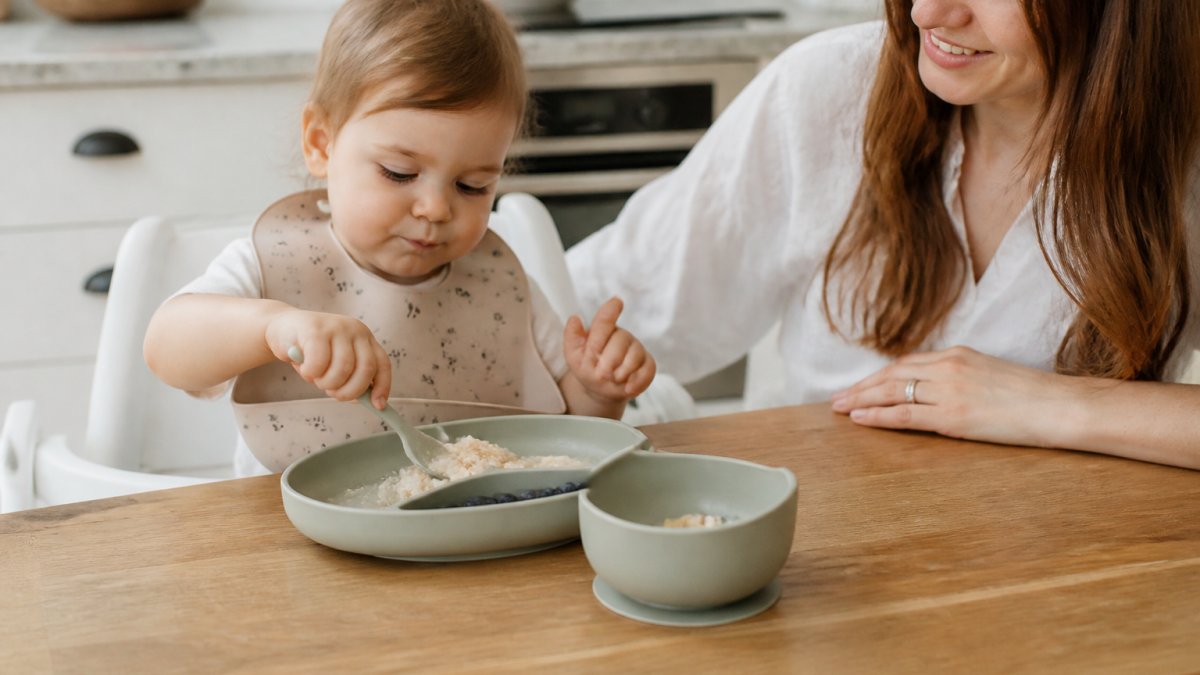
In practice, suction reduces mess but does not eliminate it. A determined toddler will find the release tab, and textured or wooden tables will not seal at all.
Our silicone bowl at $14.95 and divided plate with lid at $22.50 both use a strong suction base.
Silicone 7 piece dinner set for babies →

Care, Cleaning and Product Lifespan
Silicone feeding gear typically lasts years if you avoid abrasive scrubbers, direct contact with a naked flame or grill element, and harsh solvent cleaners. Treat it well and it will outlast several plastic sets.
A simple care routine:
- Rinse immediately after use to stop food drying in the suction groove
- Wash in the dishwasher on a normal cycle, or by hand in warm soapy water
- Sterilise according to the manufacturer's instructions, not on a whim
Watch for degradation signs, a sticky surface, a cloudy film that will not wash off, or a faint plastic smell after cleaning, and replace the piece rather than persevering.
Comparison Table: Baby Hues Eco Feeding Sets and Pieces
Here is how our range breaks down, so you can see what each piece covers, what it costs, and how it should be cared for and eventually retired.
| Product | Price (AUD) | Key Materials | Best For | Dishwasher Safe | Care Limit | End of Life |
|---|---|---|---|---|---|---|
| 7 piece dinner set | $69.95 | Food-grade silicone, 304 stainless steel | One-purchase setup from 6 months | Yes | Hand-wash stainless tines to keep them sharp | Silicone recyclable at specialist drop-off; steel scrap |
| Divided plate with lid | $22.50 | 100% food-grade silicone | Meal prep and portion planning | Yes | Avoid abrasive scrubbers on the suction groove | Specialist silicone recycling |
| Silicone bowl | $14.95 | BPA-free silicone | First independent scooping | Yes | Retire if the base goes tacky | Specialist silicone recycling |
| Plate with designs | $19.50 | Food-grade silicone | Making mealtime fun | Yes | Hand-wash printed areas to protect the design | Specialist silicone recycling |
| Sippy cup with handles | $15.95 | Non-toxic silicone | Two-handed drinking | Yes | Check the spout for tears monthly | Specialist silicone recycling |
| Placemat with animal designs | $21.95 | BPA-free silicone | Table protection and craft play | Yes | Store flat, not folded | Specialist silicone recycling |
| Palm grasp fork and spoon | $12.95 | BPA and phthalate-free silicone | First self-feeding, 6 months+ | Yes | Replace if the handle cracks | Specialist silicone recycling |
| Ergonomic cutlery set | $14.99 | Food-grade silicone, 304 stainless steel | Older toddlers, 18 months+ | Yes | Hand-wash to preserve the handle bond | Silicone and steel separated for recycling |
The bundle is the better value on paper: buying the plate, bowl, cup, placemat and cutlery separately comes to more than the set price, and you get the straw cup and feeding spoon thrown in.
Material Trade-Offs Behind the Table
The table shows what each piece is made of; the harder question is what that material costs the environment across its life:
- Silicone is derived from silica and petrochemical feedstock, so it is not a renewable material. Its environmental case rests on durability: a silicone set that lasts two children displaces several plastic sets. It is not widely kerbside recyclable, so end of life usually means a specialist drop-off or landfill.
- Bamboo grows quickly and is renewable, but most bamboo tableware is bonded with food-safe resins, which means the finished product is a composite rather than pure bamboo. It is not dishwasher-safe in most constructions, and a split bowl cannot be repaired.
- Stainless steel has a high embodied energy but is genuinely recyclable and effectively indestructible under a toddler. It is the strongest end-of-life story of the four.
Replacement Parts and Packaging
Ask two questions before you buy any set: can the pieces be bought separately if one is lost, and what does the product arrive in?
Packaging is the other half of the story. Look for paper or card that can go in kerbside recycling, and be sceptical of a product that arrives in a plastic sleeve inside a plastic mailer.
Matching the Set to Your Baby's Feeding Stage
Feeding gear should change as your baby does.
Around 6 months, starting solids: soft spoon, suction bowl, and a bib.
Around 9 to 12 months, self-feeding and baby-led weaning: divided plate, sippy cup with handles, and palm grasp cutlery.
Around 18 months plus: move to the ergonomic stainless steel cutlery with silicone handles.
Two years plus: the same pieces keep working.
Frequently Asked Questions
What should an eco-friendly baby feeding set include?
A practical set covers the pieces your baby uses at every meal: a suction plate or bowl, a cup, and age-appropriate spoons and forks. Many parents add a placemat and a bib. Bundles such as the Baby Hues Silicone 7 Piece Dinner Set ($69.95) combine a placemat, suction plate, sippy cup with straw, feeding spoon and palm-grasp cutlery, which saves buying each item separately. Check that every piece suits your child's current feeding stage, is easy to clean, and is made from a material you are comfortable with.
Are silicone baby feeding sets safe?
Food-grade silicone is widely used for baby tableware because it is soft, flexible and free from BPA and PVC when correctly made. Safety depends on the maker: look for clear material claims, dishwasher and steriliser instructions, and independent testing against Australian standards. Baby Hues products are independently tested and made from non-toxic, BPA-free food-grade silicone. Replace any piece that tears, cracks or develops a persistent smell, since damaged surfaces are harder to clean properly.
Are bamboo baby plates suitable for babies?
Bamboo plates are lightweight and biodegradable, which appeals to parents cutting down on plastic. The trade-off is care: most bamboo tableware needs hand washing and should not be soaked or put in a dishwasher, and it can crack if dropped repeatedly. Many bamboo plates also rely on a melamine or resin binder, so check exactly what the plate is made from before buying. For a baby still throwing food, silicone or stainless steel usually survives longer.
How do you clean and care for reusable baby feeding products?
Rinse pieces straight after a meal to stop residue drying on. Silicone plates, bowls, cups and cutlery from Baby Hues are dishwasher and steriliser safe, which makes the daily routine simpler. Wash suction bases and grooves with a soft brush, since food collects there. Avoid abrasive scourers on silicone and bamboo. Inspect regularly for tears, cracks or a lingering smell, and retire any piece showing wear, because damaged surfaces can trap bacteria and stop the suction working.
When should a baby start using a plate and spoon?
Most babies are ready for a plate and spoon from around six months, when they start solids and can sit upright with support. Begin with a suction plate or bowl and a soft spoon sized for little hands, and expect plenty of mess while they learn. Baby Hues palm-grasp cutlery and soft silicone fork and spoon sets are listed as suitable from six months, while the stainless steel cutlery with silicone handles is designed for 18 months and older. Move up as your child's grip and coordination improve.
Starting solids is messy, repetitive and expensive if you buy badly. Baby Hues makes it simpler with food-grade silicone mealtime sets that are independently tested to Australian and New Zealand toy standards, dishwasher and steriliser safe, and built to last through more than one child. Our range covers everything from a $12.95 palm grasp cutlery set to the complete $69.95 seven-piece dinner set. Browse the full collection and set up mealtime once, properly.